

 |
|
| Total Student Loans | |
|
|
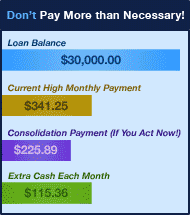
| Current Payment: | $350.49 |
| Your New Payment: | $232.59 |
| Monthly Savings: | $117.90 |
|
|
 Private & Secure Private & Secure
|
|


Investing in Your Dream: Finding the Right Student Loans for Graduate School
By: Emily A. Zaborniak
By: Emily A. Zaborniak
 |
 |

|
|
 |
 |
||
 |
|||
Well, it's all about finding the right loans to meet the needs of your graduate school expenses. Some of the most accessible forms of graduate school funds are available from the federal government. Understanding these resources can open up financial opportunities for graduate students who do not receive full, or even partial, scholarships directly from their school.
For students who do need to subsidize their graduate school education, one option to consider is that of a Graduate Stafford Loan. This loan is awarded in two versions: the subsidized Stafford Loan and the unsubsidized Stafford Loan. Researching the details of each loan encourages smart borrowing and a successful financial future. Here are some key points: First, the subsidized Stafford Loan is awarded to graduate students who demonstrate financial need. "Financial need" is determined by submitting a Free Application for Federal Student Aid (or FAFSA). This is the procedure to apply for an unsubsidized or subsidized Stafford Loan. As stated, the application will determine eligibility for subsidized, but is also necessary for the processing of the unsubsidized.
A second distinguishing factor between the two Stafford Loans is the interest benefit of the subsidized loan. While the graduate student is attending school, the government pays the interest on the loan. Additionally, upon graduation, a borrower is granted a six month "grace period." During this half-year, the recent grad is not responsible to begin repayment until the grace period expires. This affords the borrower to become financially acclimated to the "real world" and allocate their attention to the job search while being granted a reprieve from the stress of repaying student loans.
Next, the unsubsidized Stafford Loan is a very popular source of funding because it is available to graduate students, regardless of their level of financial need. However, it is important to note that the borrower is responsible for the interest that accrues while graduate students are in school, although actual repayment is deferred until after graduation. The accumulated interest is ultimately added to the loan balance.
Once a borrower is educated on the different types of interest attached to Stafford Loans, the next step is becoming aware of how the interest rates are determined and when rates are locked in. Interest rates are subject to change annually on July 1. Although interest rates can rise or fall, in recent years they have gradually risen. A wise borrower takes advantage of the benefits of consolidation by locking-in low interest rate, thus reducing monthly payments.
So, just how much money does investing in a Stafford Loan put in a grad student's pocket? This upcoming summer, July 1, 2007, Stafford Loans will increase disbursement to $20,500 per year. This jumps two thousand dollars from the current maximum of $18,500 per year. But graduate students must maintain the cool of a cautious borrower because only $8, 500 of the total disbursement can be subsidized. Often, graduate students may find themselves combining both subsidized and unsubsidized loans to make ends meet.
Although there are small fees involved in taking out a Graduate Stafford Loan, many graduate students feel these loans are still a stable means of financing a graduate education. Still, check the fees any lender charges before making any final decisions. On July 1, 2006 a 1% guarantee fee was made mandatory. A second fee, called the origination fee, is 2%. On a positive note, the latter fee is successively dropping .5% each year until completely phased out. For the borrower's convenience, fees are directly deducted from disbursement checks.
One of the most reassuring points of being an informed borrower is the freedom of choice. Federal funding is not limited to the Graduate Stafford Loan. When the Deficit Reduction Rate of 2005 was passed, the PLUS Loan's exclusivity to undergraduates was revoked, as the Graduate PLUS Loan was introduced. There is no Parent PLUS version for graduate students, unlike the undergrad loan; however, this doesn't mean the Grad PLUS loan is not without its benefits.
Do you need the extra money to pay for the "total cost" of expenses? Do you want money that will go beyond tuition, books, and more? Then, consider the Graduate PLUS Loan. The annual maximum of a Graduate PLUS Loan is equivalent to the cost of graduate school attendance, with the exception of any other aid that a student has been previously awarded. For example, if a student needs $60,000 but has been given $20,000 in other funds, then the maximum Graduate PLUS Loan that can be given is $40,000.
To qualify for a Graduate PLUS Loan, the applicant must have a solid credit history. Despite being based on a credit standing, the Grad PLUS Loan is still fully-backed by the United States Government. This ensures the potential for a fixed interest rate. If the potential borrower does not have qualifying credit, he or she can have a co-signer with acceptable credit to promise repayment of the loan. In addition to having established good credit, a graduate student must be enrolled as a graduate or professional student at least half-time in a qualified program in order to be considered for this loan. Similar to the Graduate Stafford Loan, in order to apply for a Graduate PLUS Loan, a graduate student must complete and submit a Free Application for Federal Student Aid.
There are times when a graduate student may receive departmental funding, a teaching assistantship, or a research fellowship. Also, a select few graduate students receive grants. In these cases, there are smaller, supplemental federal funds that can be taken out to make sure all the financial bases are covered.
For example, Graduate Federal Perkins Loans offer a borrower $6,000 for each year of study with a low-interest rate of 5%. To be considered eligible for a Perkins Loan, again, the candidate must fill out a FAFSA application.
Believe it or not, there are even more options available to fund a graduate school education. An alternative to seeking funds from the federal government is to pursue the route of private loan lenders. Private loans may be used for the entire cost of graduate school or may be sought in addition to federal or scholarship funds. Private loans are significantly different than federal loans; therefore, it's imperative to weigh the pros and cons before making the final borrowing decision.
A major selling point that private loan lenders can boast is that they have the ability to offer a very large loan allowance to their borrowers, which is understandingly appealing to a graduate student with a high tuition bill. Private lenders are permitted to have uncapped maximums because they are not regulated by the federal government, whereas federal aid places limits and yearly maximums regulated by the government. Private loan lenders determine loan eligibility by reviewing the borrower's credit report; if the borrower's report does not meet the lender's requirements, often the lender's will require a co-signer with a strong credit history also sign for the loan.
The simplicity and convenience of private loans make them attractive to many graduate students. Also, because private loan lenders are independent, they have the luxury to customize the borrowers' loans to suit each student's individual financial needs. Each private loan lender offers its own loan terms, yet most of them provide the same basic benefits and services. For example, many private lenders will waive application fees or deadlines. Finally, perhaps most importantly to an eager student, private loan lenders are able to disburse large sums of money quickly using fast online approvals.
In conclusion, a graduate degree can be a solid investment. But when researching your options to finance such a degree, remember to carefully weigh all of the pros and cons. As an astute graduate student, it would remiss to not consider potential downsides of private loans. For instance, federal loans have the security of being back by the federal government and thus they carry a fixed rate. Even though the overall "fixed" rate may fluctuate yearly, a borrower still has the opportunity to lock it in during consolidation. With private loans, there is no cap on the interest rates and fees lenders can charge-and, as a result, unsuspecting borrowers can find themselves buried in debts larger than they ever anticipated.
Before consolidation, private lenders often have higher expectations for quicker repayment. For example, some private lenders do not offer a grace period, so interest will accrue while students are attending school and repayment must be made in a shorter period of time. In addition, a majority of private lenders cap their repayment plans at 15 years, which can significantly increase the required monthly payment on those loans.
To make an informed decision about which loan is ideal for a specific situation, keep researching all loan types and lenders. This will allow you to be prepared and cognizant of the mandatory repayment terms.
As a final thought, remember this. If you do decide to finance you dream of graduate school with student loans, keep in mind that securing your financial future begins with controlling student debt through consolidation upon graduation. Consolidation takes all of a borrower's education loans and combines them into one loan with an easy monthly payment. Consolidation can improve a borrower's credit, reduce interest rates, and award borrowers with benefits throughout the life of their loans. Consolidation is possible for both federal and private loans and can be a crucial part of charging into the work force without the financial stress of repaying a number of student loans. After all, graduate school is hard enough. Financing it does not have to be.
|

|
|
||||||||||||||||||
 |
||||||||||||||||||||


+ Consolidate Your Private or Federal Student Loans Now! (Save Thousands!!)
Tell A Friend
 |
|
The Career Resources column is presented by EmploymentCrossing, America's leading job search site dedicated to getting people jobs.
IRS Reminds Students of "Tax-Advantaged Education Expenses" By Surajit Sen Sharma On September 11th, the IRS news release "Back-to-School Tax Breaks Help Teachers Pay Classroom Costs; Aid Parents, Students With College Tuition" stressed the importance of saving receipts and maintaining expense records to take full advantage of deductions on educational expenses and credits available on federal income tax returns for 2007. + read more |

| CALCULATORS | |
 |
Stafford Loan Payment Calculator |
|
PLUS Loan Payment Calculator |
|
Loan Consolidation Payment Calculator |